



From The Guardian

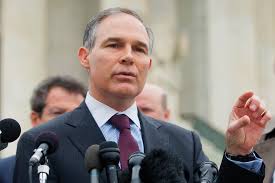
Scott Pruitt, Donald Trump’s head of the US Environmental Protection Agency, has dismissed a basic scientific understanding of climate change by denying that carbon dioxide emissions are a primary cause of global warming.
Pruitt said on Thursday that he did not believe that the release of CO2, a heat-trapping gas, was pushing global temperatures upwards.
“I think that measuring with precision human activity on the climate is something very challenging to do and there’s tremendous disagreement about the degree of impact, so no, I would not agree that it’s a primary contributor to the global warming that we see,” he told CNBC.
“But we don’t know that yet … We need to continue the debate and continue the review and the analysis.”
This stance puts Pruitt at odds with his own agency, which states on its website that carbon dioxide is the “primary greenhouse gas that is contributing to recent climate change”. This finding is backed by Nasa, which calls CO2 “the most important long-lived ‘forcing’ of climate change”.
Scientists have understood for more than a century that CO2 traps heat. Atmospheric concentrations of the gas have increased by more than a third since the industrial revolution, driven by the burning of fossil fuels and deforestation.
The Intergovernmental Panel on Climate Change report from 2014, which summarized the findings of 2,000 international scientists, states it is “extremely likely” that the steep rise in CO2, along with other greenhouse gases such as methane, has caused most of the global warming experienced since the 1950s.
Pruitt’s comments were quickly condemned by scientists, environmental activists and even his immediate predecessor as EPA chief, Gina McCarthy.
“The world of science is about empirical evidence, not beliefs,” said McCarthy, an appointee of Barack Obama. “When it comes to climate change, the evidence is robust and overwhelmingly clear that the cost of inaction is unacceptably high.
“I cannot imagine what additional information the administrator might want from scientists for him to understand that.”
Kevin Trenberth, senior scientist at the National Center for Atmospheric Research, said: “Pruitt has demonstrated that he is unqualified to run the EPA or any agency. There is no doubt whatsoever that the planet is warming, and it is primarily due to increased carbon dioxide in the atmosphere from burning of fossil fuels.
“Carbon dioxide is a greenhouse gas and we can demonstrate clearly that the observed warming of the planet would not have occurred without that change in atmospheric composition. These are scientific facts, not opinion, and it is incumbent on politicians to take account of the scientific evidence.”
Pruitt has previously equivocated on the issue of climate change, telling his Senate confirmation hearing that while he accepts the world is warming it is “hard to measure with precision” the human influence.
A core EPA function is the regulation of greenhouse gases, including CO2. Pruitt, in his previous role as attorney general of Oklahoma, sued the EPA to halt Obama’s Clean Power Plan, which imposes emissions limits on coal-fired power plants.
The plan, similar to many of the other Obama-era policies to combat climate change and safeguard clean air and water, is likely to be dismantled by the Trump administration. The president has previously called the EPA a “disgrace” and promised to reduce it to “tidbits” in order to spark economic growth.
The EPA faces severe cuts under a proposed White House budget proposal, with Pruitt set to review the agency’s role in vehicle emissions standards, methane emissions and protection of America’s waterways.
Pruitt sued the EPA 14 times while attorney general of Oklahoma and has worked in concert with fossil fuel interests in many of these cases. The recent release of thousands of Pruitt’s emails during his tenure showed an extremely close relationship between Pruitt’s office and oil and gas companies.
The EPA administrator has insisted that the regulator does work that could be delegated to the states, has overreached and needs to be reined in.
“There are a lot of changes that need to take place at my agency to restore the rule of law and federalism,” Pruitt said last month.

  • Show Comments

Your email address will not be published. Required fields are marked *

comment *

  • name *

  • email *

  • website *

You May Also Like

Climate change likely to extinguish one-third of animal parasites by 2070

Changing climate on the Earth may cause extinction of up to one-third of parasite species by ...

China fights pollution, summoned to report the mayors with little virtue

China is moving towards more sustainable policies to preserve the environment. The quality of ...

Europe is preparing a major financial response to the growing economic consequences of climate change. The European Investment Bank (EIB) Group has announced plans to provide at least €30 billion for climate adaptation between 2026 and 2030, doubling its financing compared with the previous five years. The initiative comes alongside the European Commission's new Climate Resilience Framework, signalling closer cooperation between European institutions on environmental protection and long-term economic security. The strategy reflects an increasingly urgent challenge for the continent. Heatwaves, droughts, wildfires and floods are placing growing pressure on infrastructure, agriculture and energy systems. According to the European Commission, climate-related damage caused approximately €200 billion in economic losses across Europe between 2022 and 2025. Investing in prevention is therefore becoming not only an environmental priority but also a central element of European competitiveness. A €30 billion plan to protect Europe's infrastructure and economy The EIB's new adaptation programme will support investments in water management, resilient energy networks, sustainable agriculture and infrastructure capable of withstanding increasingly severe weather conditions. Financing, guarantees and technical assistance will be made available to public authorities, businesses and financial institutions, helping transform climate adaptation projects into concrete investments. EIB President Nadia Calviño has emphasised the economic benefits of prevention, noting that every euro invested in climate adaptation can save ten euros in damage and repair costs. The bank also intends to support European companies developing innovative solutions, including water-saving technologies, advanced cooling systems and more resilient energy infrastructure. The programme is particularly relevant for regions already exposed to water scarcity, extreme heat and flooding. From Mediterranean agricultural areas to northern European cities facing growing flood risks, climate adaptation is becoming an increasingly important consideration in public investment and industrial planning. Brussels places climate resilience at the centre of European policy The financial commitment is accompanied by a broader political initiative from Brussels. On 27 October, the European Commission presented its Climate Resilience Framework, designed to improve coordination among Member States and integrate climate risks into economic and infrastructure decisions. The package includes a proposed European Climate Resilience Law, which would introduce a common approach to risk assessments, planning and institutional responsibilities. According to the Commission, Europe needs approximately €70 billion annually to strengthen its resilience to climate change. The new EIB programme represents an important contribution, although additional public and private investment will be required to address the scale of the challenge. The economic opportunities are also substantial. The global market for climate adaptation technologies and services is projected to reach €3.5 trillion by 2050, potentially creating new opportunities for European companies specialising in environmental innovation, engineering and sustainable infrastructure. By combining European policy coordination with the EIB's financing capacity, the EU is seeking to move beyond emergency responses towards long-term climate preparedness. The success of this approach will depend on how effectively investment reaches local communities, businesses and critical infrastructure. For Europe, adapting to climate change is no longer simply a question of environmental protection, but a strategic investment in its economic future.

EU and EIB strengthen climate alliance with €30 billion investment plan

Europe is preparing a major financial response to the growing economic consequences of climate ...